Personalization used to be something you only found in small shops. The owner knew your name. Remembered what you bought last time. Perhaps even set something aside because they knew you’d like it.
Today, customers expect the same feeling everywhere, even from big brands with thousands of shoppers walking through their doors every day.
That’s the challenge. How do you recognize, remember, and reward millions of customers across stores, apps, websites, and emails? All at once! Without it feeling robotic or forced.
This is where AI in retail customer engagement starts to make sense. It gives retailers a memory. A really good one. The kind that notices patterns, spots preferences, and nudges the right action at the right moment. Not just blasting promotions, but offering something that feels timely and relevant.
With strong data and the right AI retail CRM, brands can deliver AI personalization retail that feels less like marketing and more like a relationship.
The Data Foundation: Why “Good Enough” Data No Longer Works
Here’s the truth. AI is only as powerful as the data feeding it.
For AI personalization in retail to actually feel personal, the data has to be clean, connected, and reliable. Scattered spreadsheets and disconnected systems just create confusion. Instead, retailers need one place where everything comes together: customer profiles, purchase history, and interaction across channels.
That’s the role of an AI retail CRM.
Think of it as the foundation. If the data is solid, personalization works. If it’s messy, the experience falls apart. Modern CRM solutions, such as Veras Reach, bring everything into a single hub and keep records accurate and up to date. And that matters because, according to Accenture, most shoppers are far more likely to return to the brands that recognize them and remember their preferences.
In real life, this means a customer can buy online today and walk into a store tomorrow, and the associate already knows their name and past purchases. That’s the moment when AI in retail customer engagement starts to feel human.
Because without good data, predictive customer engagement is just guesswork. With it, personalization becomes natural.
Predictive vs. Reactive: The Evolution of Customer Engagement
The difference between reactive and predictive engagement is night and day.
Reactive engagement means you’re always playing catch-up. You reach out after a cart is abandoned. After a complaint comes in. After the customer has already started drifting away.
Predictive customer engagement flips that around.
Instead of reacting, you anticipate. With AI in retail customer engagement, the system studies patterns: what people buy, when they buy, and how often they return. They quietly flag who might need something next or who might be at risk of leaving.
It is where AI personalization in retail gets practical. Imagine a group of customers who buy running shoes every summer. A smart retail CRM spots that pattern and sends a timely offer just before the season starts. Not after the sale is lost. Right when the need is about to show up.
It’s a simple idea. Reach out early. Stay relevant. Protect your margins. And make customers feel like you’re paying attention, not chasing them.
The Human Side of AI: Empowering the Frontline
There’s a common worry that AI will replace store associates. In reality, it does the opposite. It makes them better at what they already do.
Most customers still value talking to a knowledgeable person. That human connection matters. What AI in retail customer engagement does is give associates a quiet boost behind the scenes.
Think of it like having a helpful assistant whispering reminders.
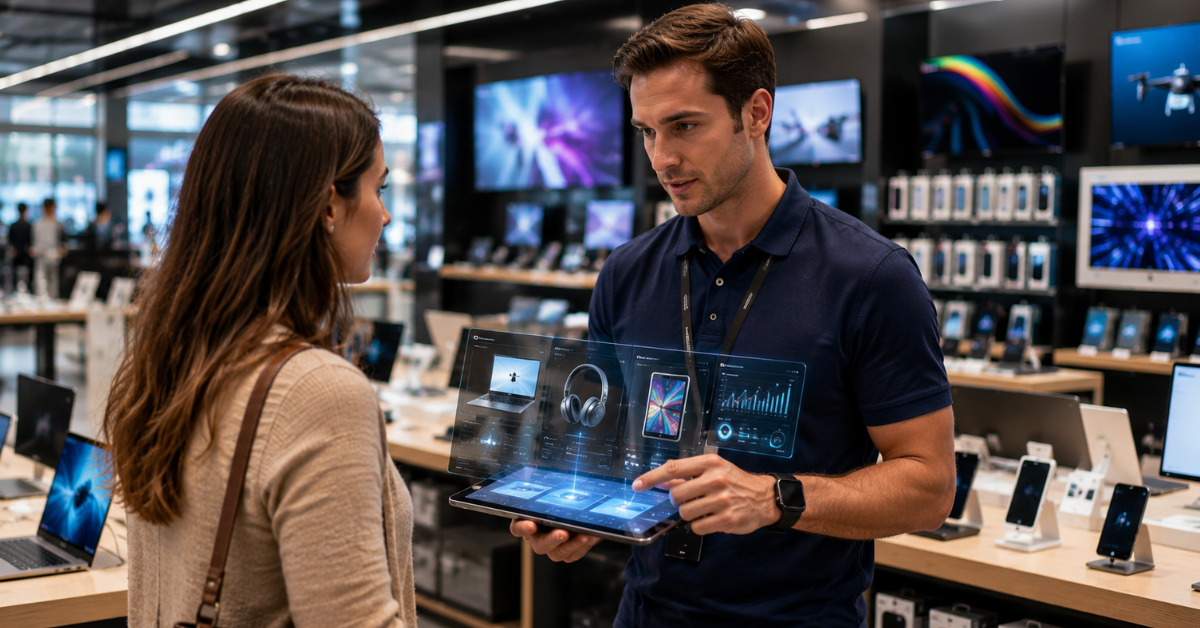
With tools built on an AI retail CRM, associates get simple cues. A customer’s birthday is coming up. A regular shopper has started browsing activewear. A VIP hasn’t visited in a while. These small signals help the associate start a conversation that feels thoughtful and not forced.
That’s the beauty of personalization retail. It provides context. The why behind each suggestion. So instead of sounding scripted, the associate can speak naturally and confidently.
Combine that with predictive engagement, and timing improves, too. Outreach happens before the opportunity slips away, not after.
In the end, AI doesn’t replace the human touch. It sharpens it. The associate stays the face of the brand. The technology just makes sure they show up prepared.
Balancing Efficiency with Ethics
Personalization only works if customers trust you. It’s the foundation.
When you’re using AI to personalize retail experiences, you’re working with real customer data: preferences, purchase history, behavior. So privacy can’t be an afterthought. It has to be part of the design from day one.
It’s why modern systems follow a simple idea. Be transparent. Give customers control.
A good AI-powered retail CRM makes it easy for shoppers to see what data you have and how it is used. They can update preferences. Request deletion. Opt out if they want. No hidden doors. That kind of openness builds confidence.
And confidence matters! When people understand how their data is used, they’re far more comfortable sharing it (Invesp). It is what keeps AI in customer engagement working smoothly.
There’s another piece too. Fairness.
Retailers need to regularly check their models to ensure decisions remain unbiased. Personalization should be helpful, not intrusive or unfair. That’s where thoughtful governance supports predictive customer engagement without crossing the line.
Do this well, and privacy stops being a risk and becomes a strength. Customers feel respected, and they stay engaged. And the relationship grows on trust, not just technology.
Future Trends: What’s Next for AI Engagement
The direction is clear. AI is going to get more personal, more helpful, and a lot more natural to use.
One big shift is the integration of generative AI into the retail CRM. Instead of marketers writing every message from scratch, the system can draft emails, texts, or chatbot replies that match each customer’s style and history. Not generic blasts. Real-time communication as if it were written just for them.
We’ll also see loyalty programs evolve. Right now, most rewards are tied to spending. In the future, AI in retail customer engagement will recognize other forms of participation, too, such as sharing a product online, attending an in-store event, or leaving a thoughtful review. All of those signals help brands understand what customers value.
And here’s the part that gets exciting. AI will keep learning as it goes.
With cutting-edge personalization tools like those used in retail, associates can adjust or rate recommendations. That feedback flows back into the system. Over time, it figures out what works and what doesn’t. Every interaction makes the next one smarter.
So the future isn’t about replacing people, but about building systems that grow alongside them. The technology keeps improving, and the CX becomes stronger year after year!
Bottom Line
Scaling personalization = getting your data right and using smarter tools to act on it.
The retailers who pull ahead will be the ones who connect their data and use AI in retail customer engagement to recreate that familiar, small-town service at a much bigger scale.
Veras Reach turns scattered information into clear, real-time insight. And when you combine that with AI-driven personalization, every interaction feels more thoughtful and relevant.
Predictive shopper engagement is really about timing, as well as knowing what matters to each customer and showing up with the right response. Do that consistently, and loyalty follows. Not because you pushed harder, but because you paid attention.
FAQs
What exactly is predictive customer engagement?
It depends on how complex your setup is, but it is usually much faster than replacing an entire ERP. A cloud retail inventory management system is designed to layer on top of what you already have. That means you can roll it out in phases, store-by-store if needed, without shutting everything down. The whole point of Veras Retail’s retail inventory software is to complement, not disrupt.
How does AI personalization in retail differ from traditional personalization?
Traditional personalization was pretty broad. Groups, segments, and general assumptions. AI personalization retail is much more fluid. It learns continuously from what customers actually do. If someone suddenly starts browsing winter coats, the system adapts right away. No waiting for the next campaign cycle. It feels responsive, almost like a real-time conversation.
Can small retailers use AI in their CRM?
Absolutely. You don’t need a giant IT department to get started. Veras Retail makes AI in retail customer engagement accessible to smaller chains, too. You can begin with simple features like loyalty tracking or targeted outreach, then build from there. The key is having one connected customer database. Once that foundation is in place, even modest retailers can see meaningful gains.
What’s AI-powered clienteling?
It’s about giving associates a helpful guide in their pocket. With our AI-augmented solution, Veras Affinity, staff can see customer history, preferences, and timely suggestions right on the sales floor. Maybe the system notes that a customer recently welcomed a new baby or started a home renovation. That prompt helps the associate start a thoughtful conversation. It still feels human. The AI just sharpens the timing and relevance!